"It's a bird! It's a plane!...It's a dinosaur!" - The Beginning of our Cloud Inquiry
 What started off as our first Nature Walk has now lead to an incredible provocation for our class! After taking the time to consolidate our initial discoveries from last week, my DECE and myself wanted to provide our students with the opportunity to elaborate more upon their student voice. Should we do a mind map? A Think-Pair-Share? All of these instructional strategies came into our heads and we decided to launch our curiousity with a read-aloud since it would allow for multiple opportunities for discussion. Given that it is only the second week of school, we wanted to find a book that sparked their interests from our Nature Walk but still had a moral message related to building our classroom community; "Cloudette" by Tom Lichtenheld was the winning choice and it was perfect!! With this story, we not only acknowledged the thinking made visible by our students (e.g. students were able to make connections to the clouds they saw outside but also how to treat others and respect differences in our classroom), but we also invited them to build upon their previous thoughts, ideas, and questions (e.g. what they saw, what they thought, etc) through conversation. Following our read-aloud and discussion, we took our class outside to explore clouds further by using our own sky as a canvas for our learning...
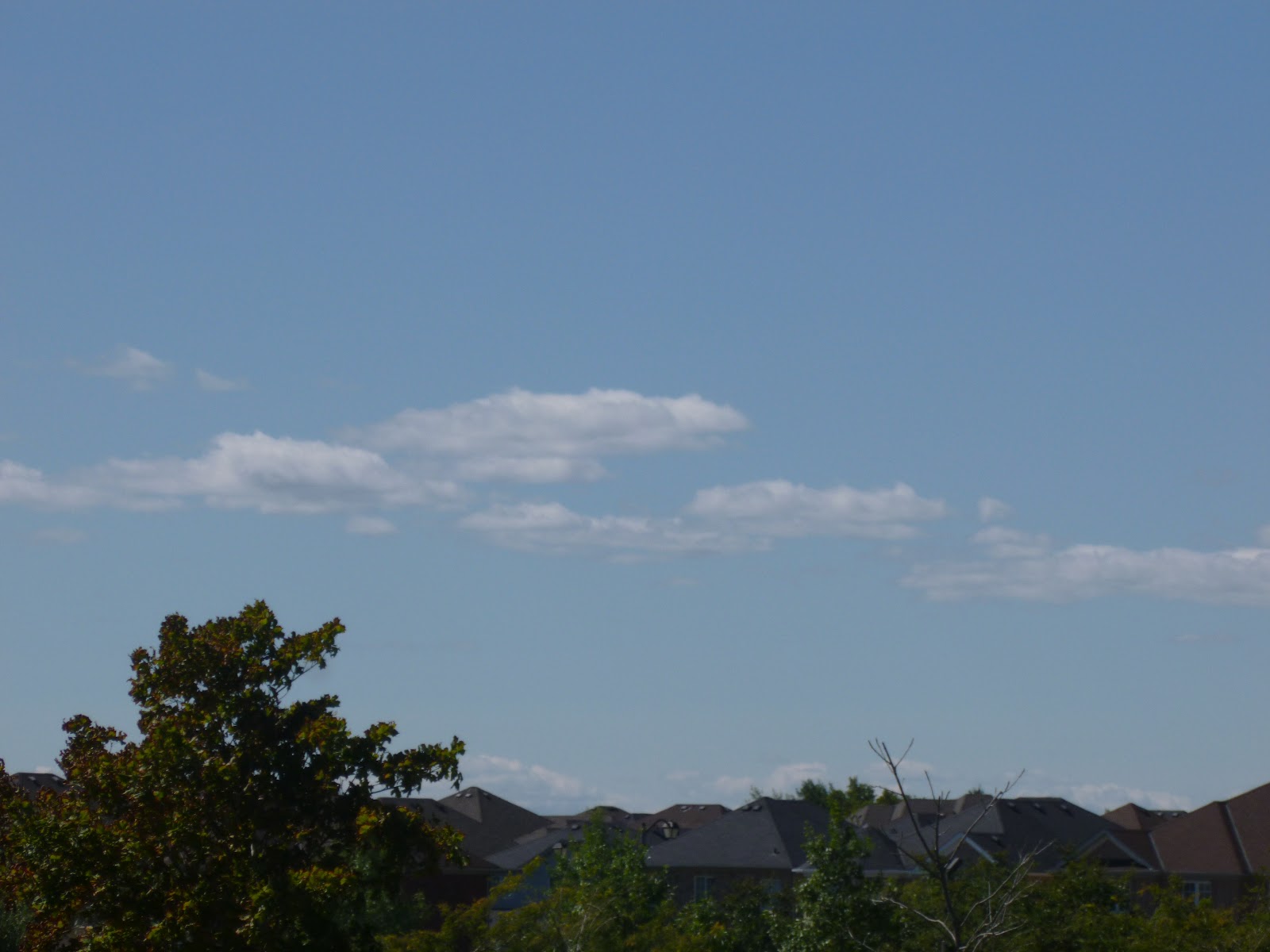
As we sat in the middle of the soccer field, we awakened curiousity by asking our students to lie down on the grass and stare up at the sky. We asked our students to use this minute of "think time" as a way to collect their ideas related to what they already know about clouds. Below are some of their responses:

"They rain." - A.M.

"They could be in shapes. All sorts of things. Look! It's the letter C!" - S.M.
"They move slow and when they're small they get bigger every time." - I.D.
"They rain whenever they want too." - J.S.

"They try to make different shapes so we can see them." - L.D.
"They go up and down in the sky." - T.B.

"Sometimes they look so fluffy like cotton candy!" - I.D.
"Clouds have water in it and it drips the rain." - G.B.
"The clouds do whatever they want to do during a thunderstorm. They are angry." - R.K.
" I wonder how the clouds make rain and thunderstorms?" - Ms. Schmidt
"When I was on top of a mountain in Switzerland, I saw the clouds make a huge blanket over the mountains." - Ms. Theis
In order to keep the flow of such responses, we decided to build upon their possible theories with another open-ended question: "Where do the clouds go when they aren't in the sky?" This question was certainly an interesting one to ask, since students were able to remember more clouds in the sky during the morning in comparison to when they were lying down. This observation led to some interesting theories:
"The wind moves the clouds. They stay where they are when there isn't wind." - J.S.
"They are too high up so we can't touch them. They stay in one spot." - L.D.
"It has to be a very windy day for the clouds to move. The wind has to push them." - R.F.
"When they aren't in the sky they are sleeping on the ground." - T.B.

One student even noticed that one patch of clouds looked different than the others, so we asked our students why do they think that happens?
"Because they are just different types of clouds. Those flat ones don't have any rain in them" - I.D.
"Maybe the wind made the cloud flat and it turned it into fog?" - L.D.
"Maybe the clouds disappear because it isn't fluffy anymore...they are becoming invisible." - A.M.
Once back in our classroom, we decided to write about the clouds we saw and afterwards, incorporate some musical elements by creating our very own rain storm as a class. From a rain stick, stomping feet, sliding hands, "shhh" voices, knee slaps and other sounds effects (e.g. "Boom!" "Crash!"), we were able to perform the old tradition of a human rain storm. What better way to celebrate their student voice and observations?!


We truly can't wait to see where this new found inquiry takes us! From integrating art with the Group of Seven to science with examining weather and the water cycle, we are only scratching the surface as we begin our planning for this wonderful learning journey! Looking forward to sharing it with you!