Slider

"Tenzies!"

Tuesday, November 11, 2014

Over the past year, I have had and continue to have the wonderful opportunity to learn and "play" many times alongside an incredible friend and inspiring colleague, Heather Jelley in our full day kindergarten classroom! Heather is one of the Elementary Math Consultants and part of the Early Years Team in the York Region District School Board who comes with a wealth of knowledge and experience in relation to Primary grades and the Full Day Kindergarten program. Not only does she infuse her passion into everything she does, but her expertise within the realm of early mathematics is infectious and has truly transformed the way I look at and teach "math" within the walls of my classroom everyday! 

That being said, I have had a ton of fun integrating a variety of "Math Games" into our comprehensive math program that I have learned from Heather! Based on my students each year, I ensure that the introduction of each math game is purposeful, meaningful and, most importantly, responsive to their needs as young mathematicians. Most recently, I highlighted a personal favourite called, "Don't get the red dot!" on the blog! If you have yet to read all about this incredibly exciting and highly engaging game, please click this link: http://ljpskindergartenteam.blogspot.ca/2014/10/dont-get-red-dot.html

I'd now like to highlight a second Math Game that is equally as popular and incredibly engaging called "Tenzies!"
Purpose: 
For students to build upon their subitizing (the ability to recognize the number of objects at a glance, without having to count all the objects), one-to-one correspondence (each object being counted must be given one count and only one count. The number word spoken and the object counted must match up), and conservation (the count of the object stays the same whether spread out or close together) skills in a hands-on and engaging way!


Materials:
All you need is 10 die (preferably all of one colour) - that's it!


How to play:
1. Roll all ten die and sort them by number rolled into groups. Whichever number has the most die is the "magic tenzie number!" Remember that number.

Modification: Avoid sorting and have students pick a number from 1-6 to be their "magic tenzie number."

2. Gather and roll all ten die again and when that "magic" number appears on a dice, take it away from the group and form a line. 

3. Gather remaining die and keep rolling; adding the "magic" number die when rolled to your "tenzie" line. 


4. Once all ten die have been lined up with the "magic" number, the player shouts out "TENZIE!" because they win!


The nice thing about this game is that it's really a competition within oneself to see how quick you can get "tenzies!" The more familiar and knowledgable students get at the early number concept of subitizing, the easier the game becomes! 


In particular, this game has been one of the best whereby I've noticed students gaining a strong, confident sense of the early number concepts mentioned above (subitizing, conservation and one-to-one correspondence). Making Math "fun" is so important when developing our youngest learners into mathematicians, and a game like "Tenzies!" is one where there's an entry point for every student and most importantly, every student can feel successful playing! 

I've created a set of "Tenzies!" instructions for you to download which were shared as part of our Great Beginnings session this past August for educators and DECE's. I've also linked the game to the Full Day Kindergarten Curriculum expectations. 


Here's to making math fun and using play as a vehicle for learning! 
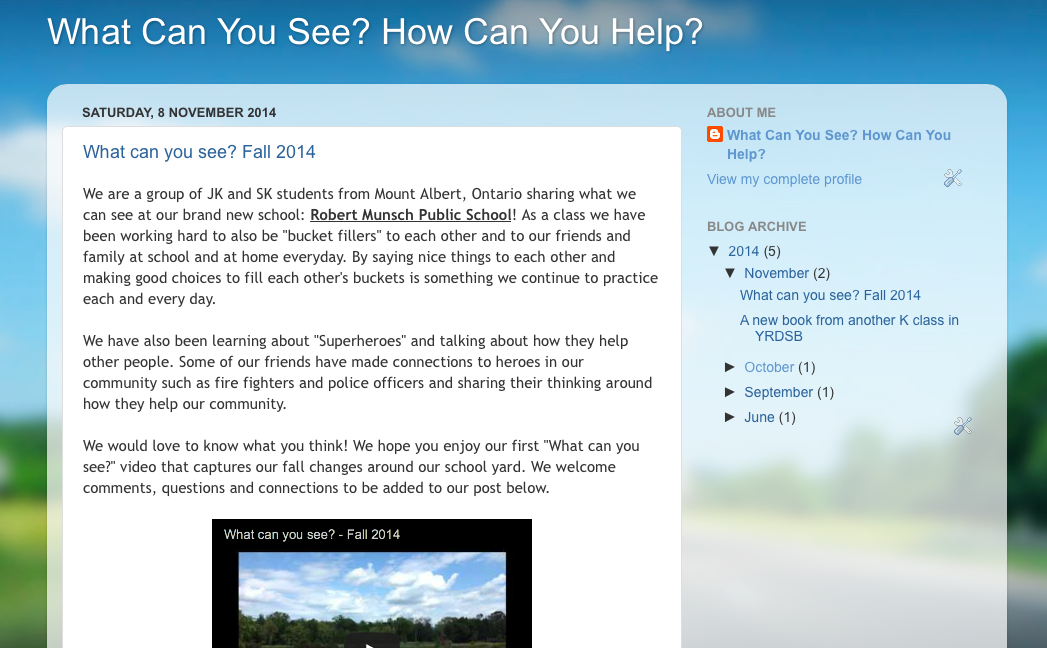
What can you see? How can you help? - Fall 2014

Saturday, November 8, 2014

Our first book as part of the "What can you see? How can you help" collaborative inquiry project has now been posted on our shared blog: 

Our class had a lot of fun walking around the edges of our new school yard and capturing all the wonderful things that we saw that help make up our school community. As part of the collaborative project this year, unlike the previous year, is that we've extended the project to include ways our students can help make a difference in our classroom, school, community and world! 

Since September, our class has been working hard at being the best "bucket fillers" they can be by saying and doing nice things to their peers and teachers within the school each and everyday. This continues to be a large focus for us and we look forward to helping others in different ways and learning about how other people help us. 

Here is our "What can you see?" video that captures the fall changes in 2014 we observed! We welcome any comments, questions and connections on our collaborative blog to extend our discussion in the classroom! 


#WCYseehelp

"Don't Get the Red Dot!"

Sunday, October 26, 2014

At this point in the school year, I always love introducing math games as part of our comprehensive math program in our classroom! Respecting the fact that developing a classroom community takes time, patience, routine-building and established expectations, I wanted to share one of my favourite math games from last year that was a student "favourite" and one that promoted strong skills when acquiring early number concepts!

We have yet to introduce this math game to our students in our classroom this year, but look forward to seeing them build upon their numeracy skills and acquire new strategies for being the incredible mathematicians that they are in the coming weeks.  

The title itself says it all: "Don't get the RED dot!"

Purpose: 
For students to build upon their subitizing (the ability to recognize the number of objects at a glance, without having to count all the objects), one-to-one correspondence (each object being counted must be given one count and only one count. The number word spoken and the object counted must match up), and hierarchical inclusion (numbers build by exactly one each time and nest within each other by this amount. This relationship means that the child mentally includes one in two, two in three, three in four, and so on) skills as early mathematicians in a fun and engaging way!

Materials:
- Each student is given a ten-frame board to play on. Counters can include any type of open-ended material/loose part (e.g. corks, coloured counters, marker caps, gems, etc). 
- Create number cards 1-10 and dot cards also 1-10 on blank playing cards
- Include one card with a red dot

 How to play:
- Each player takes a turn picking a card, naming the number (e.g. by recognizing the numeral and/or counting the dots) and then everyone showing what that number looks like on their ten-frame board
- Continue taking turns and showing each number on students'  ten-frame boards until someone picks the red dot card! This means the game is over! The object of the game is to not get the red dot! 

Encourage students to compose and decompose numbers to 10 by adding and taking away counters as the numbers change.

Here is one of our previous SK students explaining how the game works with a few twists:


This is an incredibly fun game and one that capitalizes on students' prior knowledge around numbers and build upon their understanding of those important early number concepts! 
Enjoy and remember...don't get the red dot!!

Here is an incredible reference sheet that explains the Early Number Concepts created by the York Region District School Board. I refer to this chart daily:
CopyRight © | Theme Designed By Hello Manhattan