Slider

"To develop the whole child we must develop the mathematical child." - D. Clements

Sunday, April 6, 2014

I'd like to start this post by thanking Deborah Sinyard (@sinyarddeb) for sharing with me the beautiful quote above by D. Clements. This quote struck a cord with me since some incredible mathematical learning took place in our classroom last week! Just like we encourage our students to see themselves as scientists, authors, artists, architects, and beyond we also encourage our students to think of themselves as mathematicians. A JK/SK team embraced just that and this post will highlight how through one invitation for learning, this team made some incredible mathematical connections to what we've been learning about and exploring in our classroom!

Prior to this exploration, Heidi and I have been leading mini lessons during our Math Exploration and Learning Time around teaching to particular early number concepts (e.g. "movement is magnitude," "subitizing, "stable order" and "part/part/whole") using a variety of different mathematical tools (e.g. Rekenrek, connecting cubes, etc). While one of us is instructing a mini lesson, the other is circulating, documenting student learning, and asking prompting questions to push students' thinking.

Here's what unfolded...

While the other students were engaged in their various mathematical explorations, I noticed a JK/SK team (J.L. and R.V.) working closely together with the number cards and kapla blocks....they were co-creating a number line! Each student had a hand of cards and they were taking turns picking a card from each other and placing them in numerical order on the table (from 1-10). Even if a number was already down, they matched each card and with some prompting, they constructed a "tower" out of kapla blocks to show what that number looks like. 


I noticed that both J.L. and R.V. would check each other's "towers" by counting each kapla block used and ensuring that it was the correct number of blocks (thus practicing their one-to-one correspondence skills). This reminded me of the domino card game we put out last week as an invitation for learning to practice recognizing numbers without having to count and matching the cards to the corresponding numbers on the domino. It was wonderful to see them using the new open-ended materials and applying what they learned in such an authentic way!

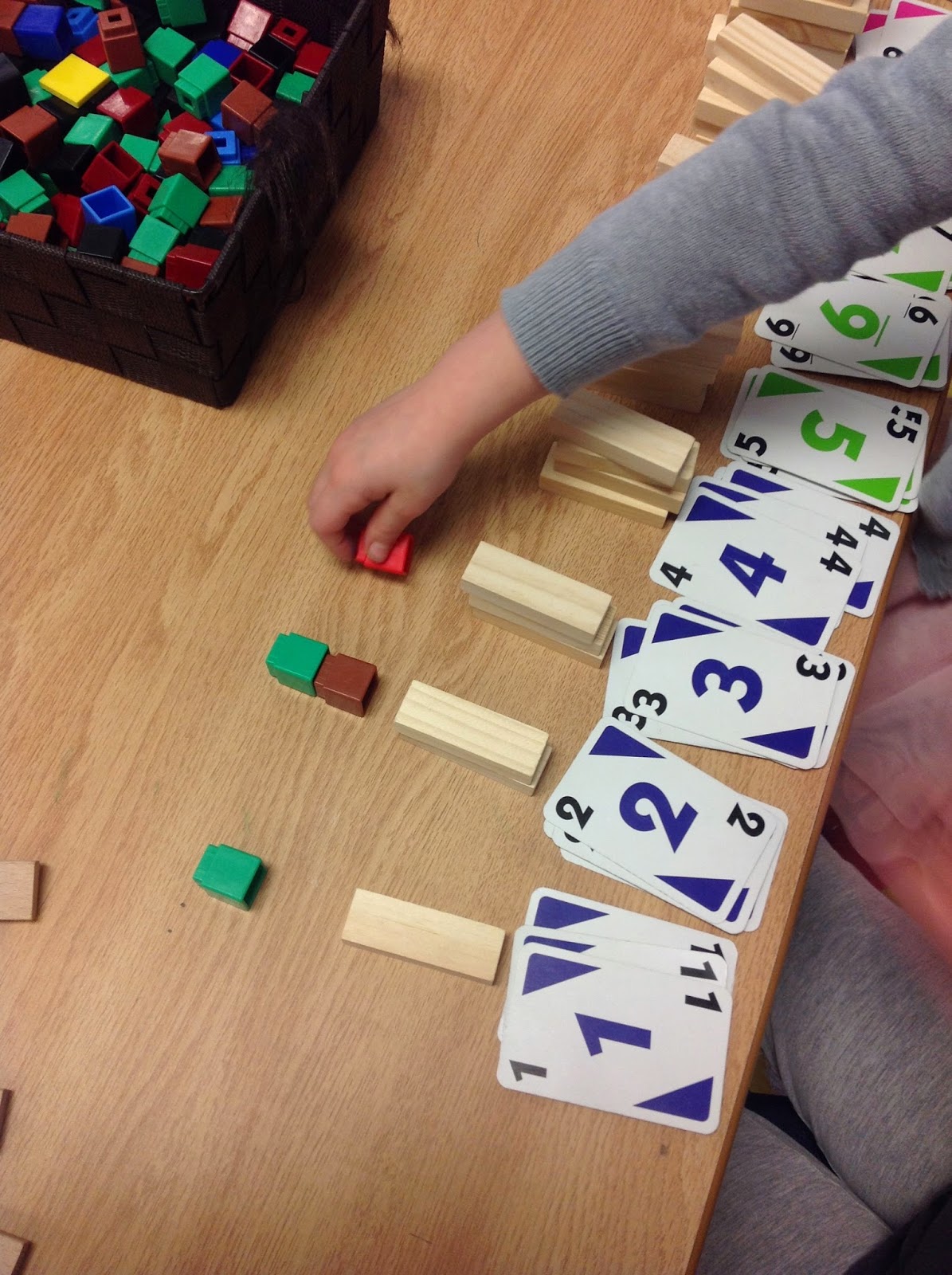


It was also great to see J.L. and R.V. make connections to our explorations of "Number Trains" and compose each number of their number line using the connecting cubes! R.V. even made a connection to creating an AB pattern!


Here are some of the question prompts I asked the girls as they were creating their number line:
1. Can you tell me what you're making?
2. I wonder how we could use these materials to show what these numbers look like?
3. Why did you choose to stack the blocks? What do you notice about the numbers? What do they look like?
4. How are all the numbers different?
5. What happens to the towers when you count forward to 10?
6. What happens to the towers when you count backwards from 10?

When asked the last two question prompts, both J.L. and R.V. came to the conclusions that when counting forward to 10 the "towers" got taller which meant the numbers got bigger and when counting backwards from 10, the "towers" got smaller which meant the numbers got smaller! Fascinating connections!

Here is some captured video documentation of the girls in action:


I'd like to thank a wonderful friend, Heather Jelley, for picking my brain and getting me thinking about my position as the active "observer" and what types of question prompts I used to get these students to this point in their learning and understanding! It certainly gave me goosebumps revisiting my recordings and transcriptions!

Here's one "Think Tank" question that Heather left me with and I welcome any thoughts and ideas! 

How do you invite/engage/provoke learning in your classrooms with a math focus?

Sharing our journey

Wednesday, March 12, 2014

Throughout this school year, Heidi and I have had the fortunate opportunity to be
"Learning@School" teachers within our school board. By working with the York Region District School Board's Early Years Team, Learning@School teachers open up the doors to their classrooms and host scheduled visits whereby school administrators and teachers can have the opportunity to observe, review elements of classroom practice, discuss "flow of the day," witness various forms of technology in action, and make note of the classroom environment and how it's set up for learning. 

Within these learning opportunities and through dialoguing with various teaching teams, Heidi and I came to the realization that a "take-away package" would be the best way for teachers to feel like we answered most/all of their questions. Considering most teachers are visual learners, we use this "take-away package" as a way to self-select the photographs we feel comfortable sharing of our classroom (since the walls of our class are often full of student photographs, names, etc) and provide our visitors with something they can refer back to upon planning, reflecting and sharing their journey with colleagues once they are back at their own schools.

Here are a few of the pages included in our "take-away package" and our hopes are that they can act as inspirational starting points for other teaching teams: 


The following list of "Must-Have" items has been created based on our own personal
preferences as a teaching team and by no means reflects any mandated
Full Day Kindergarten requirements from the York Region District School Board. 
To conclude this post, I just have to share a truly humbling email that I received this week from a teacher from Bayview Fairways P.S. who most recently visited our classroom with her teaching team. It is opportunities like this whereby we, as educators, can build capacity across our board, instil inspiration amongst us as professionals and continue to learn and collaborate!

Hi Jocelyn & Heidi,

Thank you for making that remarkable day happen, I have personally waited 2 years to see and experience this beautiful partnership in real life. Giving us ideas where we can start the process of putting decision and plan as a team into effect is the beginning of our team future learning journey. Thank you for answering our questions through your spectacular demo FDK class, I have learned so much from you guys as a real team. I look forward to learning more. Thank you again for sharing with us such a wonderful arranged marriage in real FDK environment. I am very grateful to get to know both of you. 

Thank you so very much Jocelyn & Heidi.. 

G.
Bayview Fairways P.S

A visit to the aquarium...

Tuesday, March 4, 2014

Last Friday, we had the wonderful experience of visiting Toronto's new Ripley's Aquarium. As a teaching team, we thought this was the perfect opportunity to use a field trip experience to support and enhance our current inquiry into oceans since students would see firsthand, all of the ocean life they've been inquiring about over the past month and a half.


When planning for a field trip, Heidi and I truly believe that it has to either support, enhance and/or celebrate the learning going on in the classroom. In this sense, we do not plan field trips unless they are relevant to the learning going on.
What do you see?
With this mentality, we feel like the experiences thus far that have supported our class inquiries both this year and in previous years, (e.g. visiting Buttonville Airport to support our Airplane/Airport inquiry, visiting McMichael Art Gallery's Tree Exhibit to support our Tree Inquiry) have truly made for meaningful learning opportunities before, during and after each experience for our students and us as a teaching team. 
Sea anemones, clownfish, puffer fish and more!
Students engaged in an Aquarium Scavenger Hunt using the riddles they
came up with in class as clues!
We hope you enjoy the captured photographs from our most recent trip to the aquarium and we look forward to sharing with you how this experience has pushed our thinking back in our classroom! Stay tuned!
"What kind of shark is this? It's not a great white because it's not as
big as a great white shark." - T.B.
"I see the sharks' gills and big teeth!" - E.S. 
"The stingray has a long stinger and uses its flaps to swim in the
water. How come some are big and some are small?" - R.K.
The diver was not only giving away high 5's, but he was also feeding
the stingrays!
The jellyfish were most certainly the highlight of the trip!
"I see all the tentacles and I wonder how they change colour
and swim with no eyes?" - C.S. 
"The starfish have their mouths underneath but they have no eyes.
I wonder how they stick on the glass?" - V.D.
Students even got to touch Horseshoe crabs and see what they feel like.
Do you see the sea horse? Do you see the pacific kelp?
CopyRight © | Theme Designed By Hello Manhattan